
I've come to the conclusion that campers are pretty cool.
However, the prices of campers aren't cool. Not cool at all. Premade camper builds start around $75,000 and go up from there, depending on size and features. It's very possible to spend $200,000 or more on a camper, which is a huge amount of money for something I'd use 5-10 times a year. Plus, as with anything that's pre-made, there are always design compromises to streamline assembly or reduce costs (meaning I'd have to immediately tear my new premade camper apart to fix that stuff).
So, why not build my own?
You may feel tricked at this point. "Why on earth is this weird furry cryptid rambling on about campers? The article title is clearly "2007 GMC Sierra 2500HD", which isn't a camper at all." Well spotted, friend!
I spent a lot of time deciding the features I want in a camper, how much space I needed, and what sort of fuel economy and operating expenses I was willing to accept, and then worked backwards from there to arrive at a vehicle selection. Some of my criteria:
Now, all of this would seem to point to the humble Sprinter van (or the similar Ford Transit or Ram Promaster). And they do hit most of these targets, except for parts/service cost and the base vehicle cost. Van living is super popular in Colorado, and I was having trouble finding AWD turbodiesel vans for anything less than $30k!
So, I started looking at pickup trucks produced pre-2010 (to avoid the extra cost/complexity of DEF systems). The nice thing about a pickup truck is the mechanical simplicity; most truck beds are held on with 6-8 bolts and then can be easily removed. My partner has some welding skills, which we could use to build a flatbed platform to serve as the base of the camper. The benefit to this approach versus an in-bed camper is that we're not wasting space and weight with the truck bed itself, and I can build out the camper body to my exact specifications. Plus, truck 4x4 systems are substantially more robust that those you find in a typical van, and everything is easily accessible from the underside of the truck.
I kept my eyes on the local dealerships and classifieds, and finally found a truck that fit all my prerequisites. Without further ado, here it is:

See, I told you this article was about a 2007 GMC Sierra 2500HD! Here it is, finally!
We found this truck at a dealership in Longmont CO, literally the week of Denfur 2024. We took it for a test drive and then went straight to the McCaslin RTD station and left it parked for the weekend.
Obviously as a nearly 20 year old work truck with over 300k miles, we had a bit of cleanup work to do. I sanded and repainted the front bumper first, and went through the interior to catalog a few missing/damaged items (door lock tabs, a small tear in the passgenger seat, some sub-par weather stripping). We also found a leak in the windshield sprayers and replaced the air filter and batteries. I then spent the next 8 months driving the truck regularly to hopefully identify any other issues, which helped us find leaking rear axle seals, aged rear shocks, and some minor electrical issues with the bed taillights. Note this is an aftermarket service body, not the OEM bed, and it's heavily rusted on top of that.
Not a big deal, because we weren't planning on keeping the bed anyway!
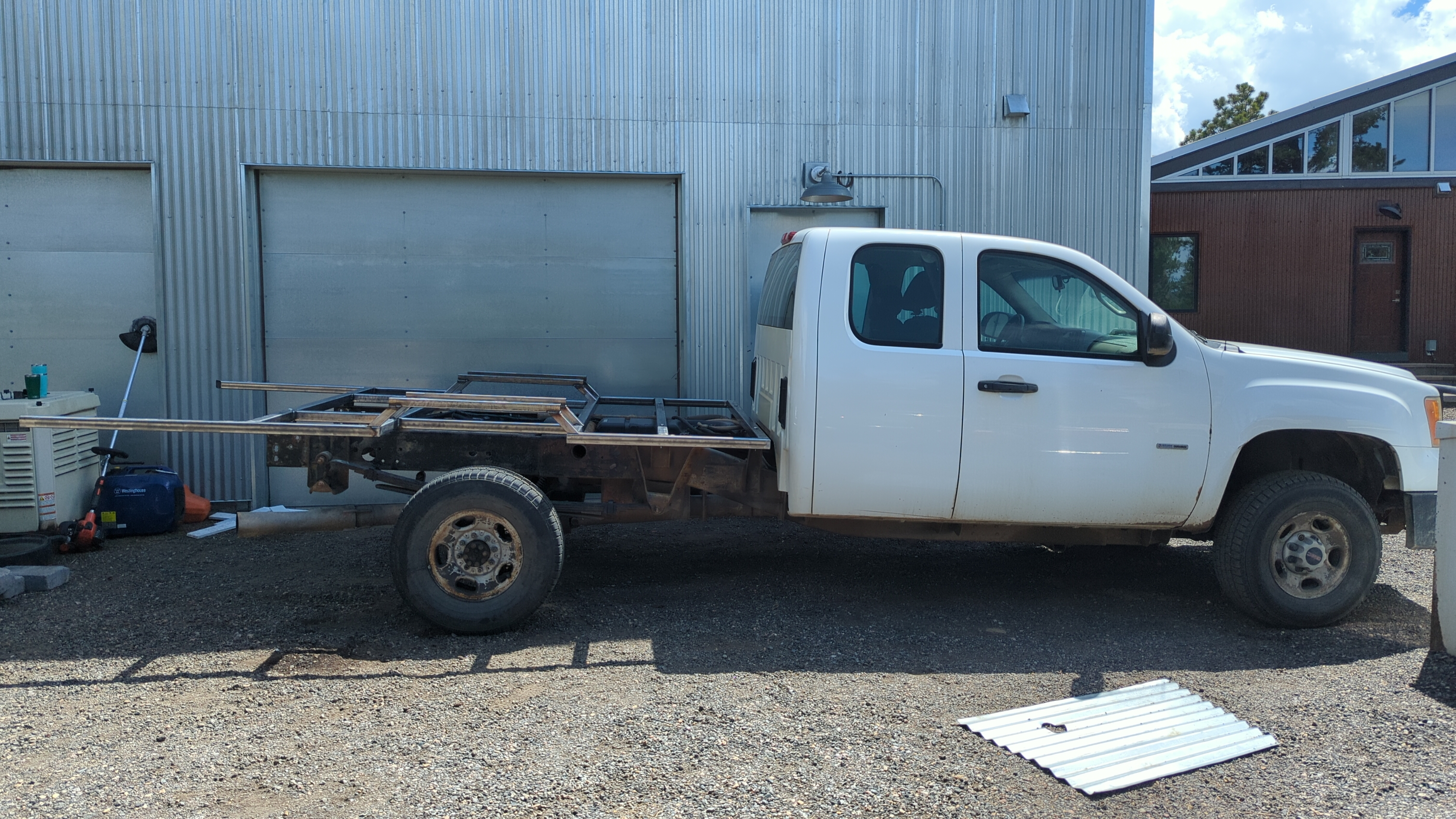
Here's the truck with the service body removed, and the beginnings of our new frame in place. The goal here is to build a steel subframe, then basically build a box around that using lumber. The outside of the box will be fiberglassed and painted for weather resistance. We could have tried to build something in the existing bed, but that would have only left us about 48 square feet of usable space and the metal would have made for an excellent thermal bridge (not what you want when you're trying to heat or cool an interior space).
One feature I'm really excited for is the rigid pop top configuration. I borrowed a lot of inspiration from build videos provided by The Travelling Together Journal (start with this video). There are three reasons I want to build the camper this way:
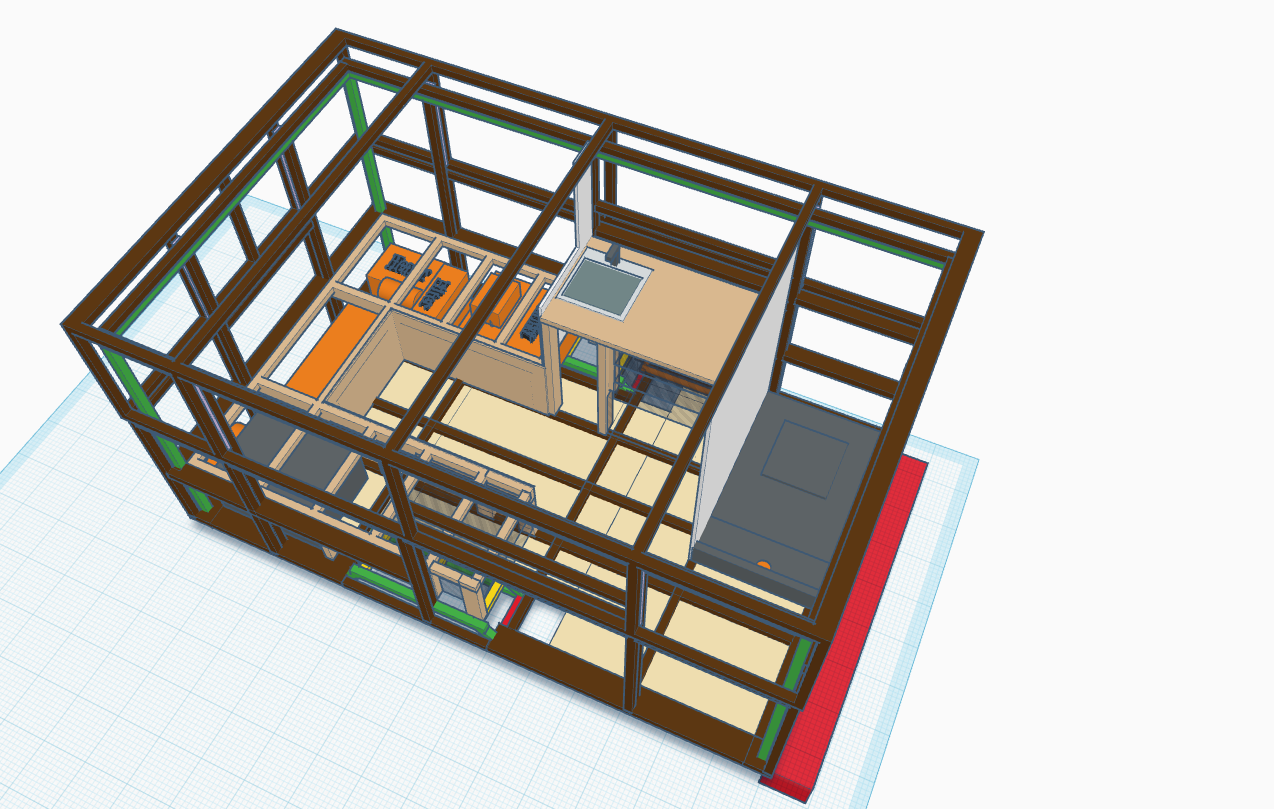
Of course, we couldn't just throw this together. I spent a ton of time rendering things out in Tinkercad (while it's not really designed for this type of work, it was easy enough to repurpose). Here's my current render:


I've left the back wall off, but that's where the main entry/exit door is locatated. There's also a pass-through from the truck cab to the camper shell located on the opposite side. There's enough room for a seating/bed area, a small kitchenette, and a wet bath with a shower and composting toilet (no black water tank here).
And of course, I've also taken it a step further and rendered out the location of every interior beam, all of our major accessories, etc. as shown here:
And here's how the truck looks now! We've completed the steel framing, and we're waiting for the weather to improve so we can start working with lumber and insulation. The floor and ceiling will be 2" thick and insulated with XPS foamboard, while the lower walls will be 3.5" thick for about 2/3 of their height and 1.5" thick for the last 1/3 of their height (they will overlap with the roof down). This should give us exceptionally high R-values for every surface well above what you'd get in a van conversion (again, factoring in the thermal bridging as a result of the metal van body).
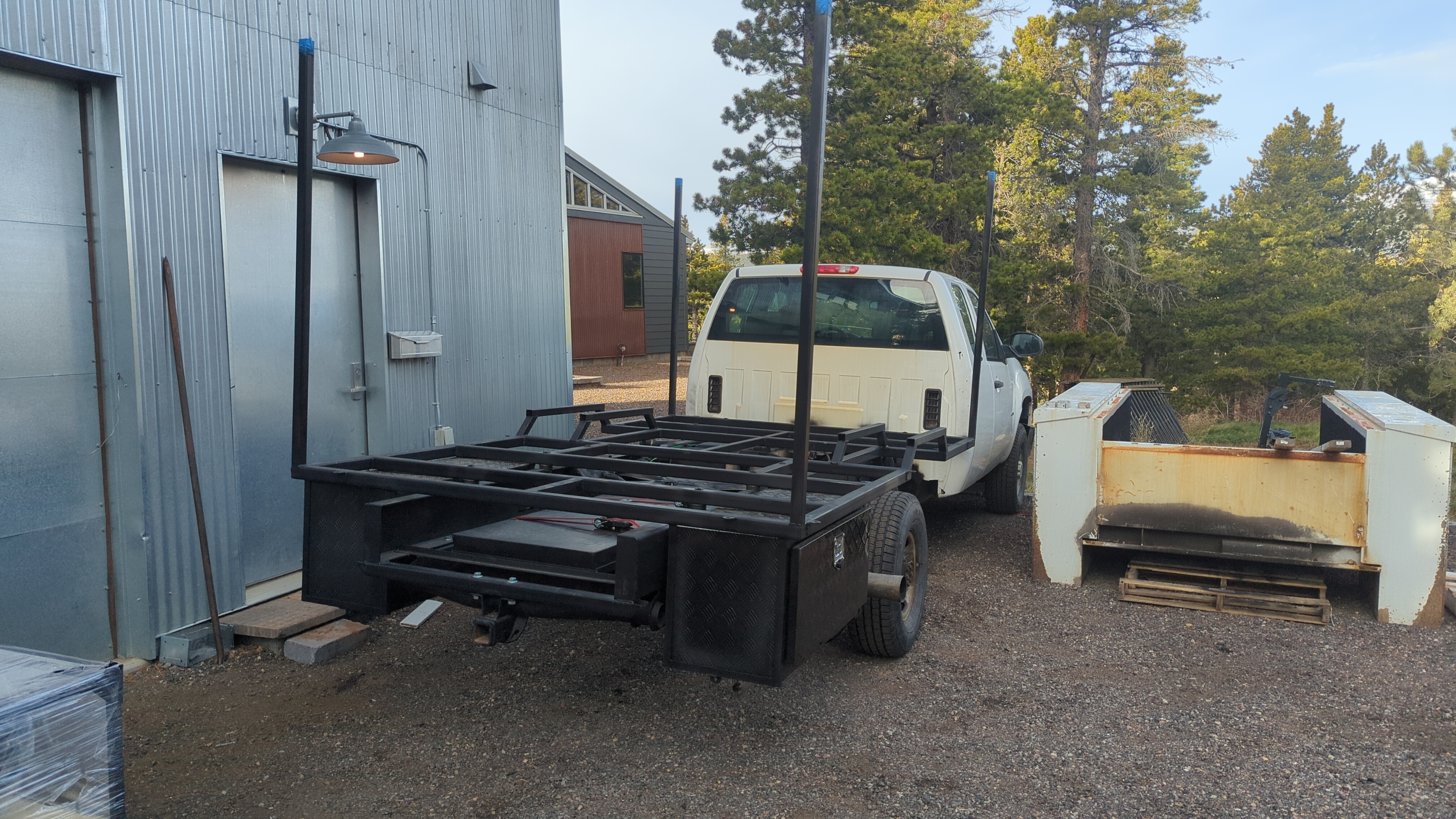
This is the current state of the camper as of December 2025. In this picture, you can see the frame has been extended by about 3 feet to accommodate the camper box. The two tool boxes under the frame add space for the diesel heater and some tool storage (passenger side) and a slide-out propane grill and miscellaneous storage (driver side).
The plan is to have the following amenities:
My next article will go into more depth on these individual systems. Keep an eye out!
Camper Electrical
Website coded by Delta Sierra, all content copyright Delta Sierra (unless otherwise noted). Hosting provided by Neocities.